
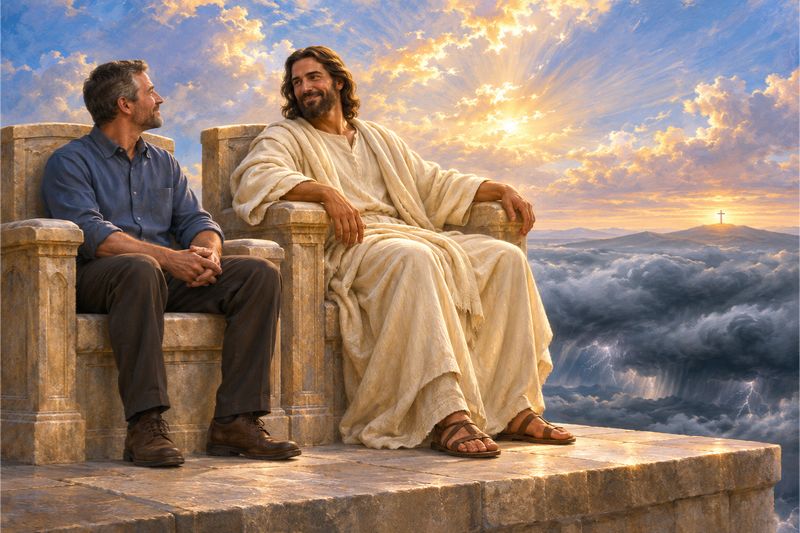
And hath raised us up together, and made us sit together in heavenly places in Christ Jesus.
— Ephesians 2:6 (KJV)
What does it mean to be seated in heavenly places? It means you live from a finished position instead of reaching for one. God made the seat with Christ already, and He made it in the past tense. The week in front of you looks different once that truth drops from your head into your heart.
Most believers run the other way. They treat the heavenly seat as a prize at the end of a long climb, so they climb. They pray harder, perform better, and brace for the next hit from the ground floor, staring up at a position that was handed to them the day they were born again. Others learn the right steps, then quietly start trusting the steps. This post gets you off the ground floor, and it fixes your heart on the One who put you in the seat.
God Seated You in the Past Tense
Read Ephesians 2 slowly, because the grammar is the message.
But God, who is rich in mercy, for his great love wherewith he loved us, Even when we were dead in sins, hath quickened us together with Christ, (by grace ye are saved;) And hath raised us up together, and made us sit together in heavenly places in Christ Jesus.
Ephesians 2:4-6 (KJV)
Count the verbs. Quickened. Raised. Made us sit. Every one is finished action, and God is the subject of every one. Paul does not say you could be raised if you qualify, or that you will sit once you have proven yourself. He reports what happened, the way a court reports a verdict.
Now look at the phrase that holds the whole thing up: in Christ Jesus. Your position does not rest on your record. It rests on His. When He was raised, you were raised in Him. When He was seated, you were seated in Him. The parenthesis tucked into the middle of the passage says it plainly: by grace ye are saved.
Heavenly places is not a cloud somewhere in the distance, either. Ephesians uses the phrase five times, and the five uses draw a map. God has blessed us there with all spiritual blessings in Christ (Ephesians 1:3). Christ sits there (Ephesians 1:20). So do you (Ephesians 2:6). The principalities and powers get put on notice there through the church (Ephesians 3:10), and the wrestling happens there too (Ephesians 6:12). This is the real realm, the one standing behind everything your eyes can see, and your address in it is fixed.
A seat like that is a gift, and a gift is received, never earned. Paul promises that they which receive abundance of grace and of the gift of righteousness shall reign in life by one, Jesus Christ (Romans 5:17). Receive is the operative word. Reign is the result.
I remember one preacher putting it in a picture worth borrowing. He hands his Bible to a man on the front row, then asks the crowd how he would answer if that same man walked up and said, “Can I have your Bible, please?” The honest answer is silence. You already have it. Asking God to place you where He has already placed you is the same awkward silence, only pointed upward. He does not need persuading. He needs you to receive what He finished.
Pride loses its footing here, too. A seat you earned would hand you something to brag about. A seat you were given hands you only something to thank Him for. Paul closes the loop two verses later: not of works, lest any man should boast (Ephesians 2:9). Your authority is His authority, exercised by agreement, and it is only as strong as your agreement with Him.
Why Jesus Sat Down
A posture says something. In the old temple the priests never sat, because the work never ended. Sacrifice after sacrifice, day after day, and not one chair in the building. Hebrews 10 sets the contrast.
But this man, after he had offered one sacrifice for sins for ever, sat down on the right hand of God; From henceforth expecting till his enemies be made his footstool.
Hebrews 10:12-13 (KJV)
Jesus sat because the job was done. One sacrifice, forever, and the matter of sin was closed. Notice the second half of that passage, too. He sits expectant, never anxious, waiting on the enemy’s final defeat, and He has seated you beside Him to enforce by faith what He won. Where He sat matters just as much as why, and Ephesians 1 gives the address.
Which he wrought in Christ, when he raised him from the dead, and set him at his own right hand in the heavenly places, Far above all principality, and power, and might, and dominion, and every name that is named, not only in this world, but also in that which is to come: And hath put all things under his feet, and gave him to be the head over all things to the church.
Ephesians 1:20-22 (KJV)
Lay the two chapters side by side. Christ sits in the heavenly places, far above every principality and power. God then seats you together with Him, in the same place. Whatever stands far above Him stands far above you. The rulers of darkness do not outrank the One you are seated with, which means they do not outrank you.
Colossians 2:15 shows what He did to them on the way up. He spoiled principalities and powers, and he made a shew of them openly, triumphing over them in it. Satan is a defeated foe. The only leverage he has left is whatever ignorance, unbelief, and fear you hand him, so stop handing it over.
I walked through the working side of this in the authority you carry over the enemy, where Luke 10:19 gives you power over all the power of the enemy. Authority is what you exercise. The seat is the place you exercise it from.
Anchor Your Heart on the One Who Seated You
Here is where a lot of sincere believers get bogged down. Everything you have read so far can be turned into a technique. Find the verse, say the verse, believe you receive, repeat until the mountain moves. None of those steps is wrong. Jesus Himself said that what things soever ye desire, when ye pray, believe that ye receive them, and ye shall have them (Mark 11:24). The steps are biblical. Trouble starts when the steps quietly replace the Person.
Believe the promise, but trust the Person behind it
God’s promises are real, and they are generous. Peter calls them exceeding great and precious promises (2 Peter 1:4), and the writer of Hebrews tells you to follow those who through faith and patience inherit the promises (Hebrews 6:12). Standing on a specific verse, asking in faith, and refusing to talk yourself out of what God said is not immature. It is obedience. Ephesians 2:6 is one of those promises, a written statement of where you sit.
But a promise is only as good as the one who made it. A signed deed carries weight because of the name at the bottom of the page. Paul says the same of every promise of God: in him are yea, and in him Amen (2 Corinthians 1:20). Yea and Amen live in Christ. The verse points to a Person, and the Person is the one you are trusting. Jesus once told religious scholars who knew their Bibles cold that the scriptures they searched testified of Him, and that they would not come to Him to have life (John 5:39-40). You can memorize every promise in the book and still miss the One it was written about, as the scholars of His time did.
Grab the handle, and let His right hand do the holding (Psalm 139:10).
Abraham looked at God, not at his own technique
He staggered not at the promise of God through unbelief; but was strong in faith, giving glory to God; And being fully persuaded that, what he had promised, he was able also to perform.
Romans 4:20-21 (KJV)
Watch where Abraham’s attention went. He staggered not at the promise, and he was strong in faith, giving glory to God. His eyes landed on the character of the One who had spoken. Fully persuaded that God was able is a statement about God, not about the tightness of Abraham’s grip. His strength came from the Person, not from a flawless performance.
Sara tells the same story from the other side. Through faith she received strength to conceive seed, because she judged him faithful who had promised (Hebrews 11:11). She judged Him faithful. Her confidence rested on His reliability, not on her own spiritual precision, and she was well past the age when precision could have helped.
Two ditches, and the road between them
Picture a road with a ditch on either side. The first ditch is waiting to feel the right way before you dare act on what God has already written. I know it well. Some of the older devotional writers left me closing the book with one question: now what do I do? I tried to manufacture brokenness. I tried to feel surrendered enough. I wondered how long I was supposed to wait and whether I was really hearing Him, and the questions never ended, because my eyes were fixed on my own spiritual temperature. That road ends in self-condemnation, a trap I address in overcoming self-condemnation.
The second ditch sits on the other side of the road, and it’s just as deep. This one is mechanical faith, where the power seems to live in how well you do it. Say it exactly right, believe it hard enough, picture it clearly enough, and God has to come through. Over the years, plenty of good Bible teachers made faith easy to understand and easy to act on, and I’ve leaned on their explanations with a lot of people. I don’t think any of them meant it as a formula. But it’s easy to hear a clear teaching and turn it into a machine. Then the answer runs slow, and the machine points the finger at you. You must have done something wrong.
The road between the ditches is simple. Take the steps, and keep your heart on the Person. Find the promise. Ask. Believe you receive. Speak in agreement with what He said. Then rest your heart in the One who loves you and keeps His word. The steps give your faith a direction. The Father is the reason it holds.
Notice the word heart. Faith lives there, not in the mind. Your mind will keep running the numbers and rehearsing the problem, and you can renew it, but the believing that moves mountains rises from a heart settled on who God is. Paul describes faith as the kind which worketh by love (Galatians 5:6), and Hebrews tells you where to aim your eyes: looking unto Jesus the author and finisher of our faith (Hebrews 12:2). Not looking unto your faith. Looking unto Him.
This is why the seat is such good news. You did not get there by a technique, and you do not stay there by one. A Person put you there. Ephesians 2 opens with God, rich in mercy, and He is the subject of every verb. Your job is to keep your heart fixed on the Giver. Christ in you is the engine of this whole life, which is what I unpacked in the truth of Christ in you, and the steps are simply how you cooperate with Him.
What Seated Looks Like on an Ordinary Tuesday
Picture two believers who get the same bad call on the same Tuesday morning. The first hears it from the ground floor. The report towers over him, his stomach drops, and by lunch he is bargaining with God and rehearsing the worst outcome. The second takes the same call, and something older and deeper answers it. She knows where she is seated, and she knows Who seated her, so she hears the report as information about the circumstance, not as a verdict on her future. Same call. Different seat. It’s a wildly different week.
A truth that only works on Sunday is a hobby. Here is how the seat shows up when the diagnosis, the invoice, or the phone call lands.
Judge by the seat, not by the feeling
You will not feel seated. Your five senses cannot detect your spirit, and your emotions belong to the soul. The mirror, the bank balance, and the mood you woke up with all report on the body and the soul. None of them has jurisdiction over where your spirit sits.
Faith takes its report from the Word, and faith lives in the heart. The mind is the gate that report has to pass through, which is why Paul tells you to be transformed by the renewing of your mind (Romans 12:2). Renewing is how a truth gets past the gate and settles in the heart, where believing actually happens.
If ye then be risen with Christ, seek those things which are above, where Christ sitteth on the right hand of God. Set your affection on things above, not on things on the earth. For ye are dead, and your life is hid with Christ in God.
Colossians 3:1-3 (KJV)
Setting your affection on things above is not a mood you work up. It is a decision about where you will look from. Look at the problem from the ground and it towers. Look at it from the seat and it sits under His feet, along with all things (Ephesians 1:22).
Read the last line of that passage again: your life is hid with Christ in God. Whatever the enemy is aiming at, he has to get past Christ, and then past God, to reach you. You could not ask for a safer address.
Look to Him first, then speak from the seat
Before you say a word, turn your heart toward the One who made the promise. Thank Him that He is faithful. Remind yourself who He is, because that is what steadies you when the problem is loud. Then speak.
Confession is agreement. When you say out loud that God raised you up together with Christ and made you sit together in heavenly places, you are not manufacturing a reality. You are agreeing with one. Keep the order straight, though. Your faith stands in God, never in the mechanics of confession. The words only carry what the heart already holds, for of the abundance of the heart his mouth speaketh (Luke 6:45). If you lose your place in the wording, nothing collapses, because the weight was never on the wording.
The principles apply to everything in life. We could be talking about your relationships, your finances, and everything else that touches your life in this world. God doesn’t just give us the tools and say, “I’ll catch up with you later. Do a good job and don’t doubt.” No, He’s right there with us as we go through the tests and trials that we face in this world. Sometimes, we do stupid things and make bad decisions. As a result, we face problems that appear to be of our own making.
At other times, it seems like we’re doing all the right things, but the challenges still come. The boxer doesn’t ask his trainer why his opponent is trying to knock him down. He knows why. There’s nothing “strange” about it. Likewise, we’re the fighters of our generation. Those who’ve come before us are cheering us on as we fight the good fight of faith and run the race set before us.
Take your authority and drop the pleading
Prayer from a lower seat sounds like pleading. Prayer from the heavenly seat sounds like Peter at the Beautiful Gate: such as I have give I thee (Acts 3:6). He did not beg God to start working on a lame man. He spoke in the name of Jesus and released what was already his to give.
Jesus laid out the same pattern for mountains. He tells the believer to speak to the mountain, and to speak without doubt in his heart (Mark 11:23). You address the problem, not the Father. You thank the Father that it is done, then you tell the mountain where it sits.
Seated Does Not Mean Passive
Do not hear any of this as permission to coast. The same Paul who writes seated in chapter 2 writes stand in chapter 6.
Wherefore take unto you the whole armour of God, that ye may be able to withstand in the evil day, and having done all, to stand.
Ephesians 6:13 (KJV)
Both are true at once. You stand from the seat. You do not fight to win a victory, because you fight from one that is already won. Paul is blunt that the wrestling is real, and he names the opponents: principalities, powers, and spiritual wickedness in high places (Ephesians 6:12). Resistance is real, and the enemy is its source.
This matters most when an answer seems slow. Delay does not come from the Father. He settled the matter the moment you prayed, and the enemy is the one working to hold the manifestation back. I dig into that in why God is not the author of your tragedy, and into the stamina side of it in persistent faith against persistent problems. Standing is how you outlast the resistance.
Here is where the anchor matters most. If your faith rests on a formula, a slow answer sends you hunting for the broken step. Did I say it wrong? Did I believe hard enough? Did I skip something? You end up auditing yourself while the enemy gets a free run. If your faith rests on the Person, a slow answer sends you back to His character. He is faithful. He said it. He cannot lie (Titus 1:2). The resistance is real, and so is the One who stands behind the promise, so you keep your heart settled and keep standing.
Notice what that stance looks like. Feet planted. Nothing to prove. No scrambling for position, because the position was never in question. The fight that remains is mostly over what you will believe and what you will say, and the enemy’s whole strategy is to talk you out of the seat. He will tell you the seat is a nice idea and the problem is the real world. Refuse the argument, and the rest of the armor has something solid to hang on.
Your Action Step
Today, before you do anything about the thing pressing on you, take your seat on purpose. Start with a minute on the Father, not the problem. Thank Him for His faithfulness, and let the thought of who He is settle in your heart. Then read Ephesians 2:4-6 out loud, slowly, and let the verbs land. Name the pressure and say where it sits in relation to Christ: beneath His feet. Write Ephesians 2:6 on a card and put it where you will see it when the pressure peaks, and each time you see it, speak it.
Then do the one thing the Word puts in front of you. Make the call. Pay the bill. Lay hands on the sick. Forgive the debt. Move from the seat, not from fear.
Father, I thank You that You raised me up together with Christ and made me sit together with Him in heavenly places. I am not climbing toward that seat. I am seated in it. I am not trusting my technique, my wording, or my feelings. I am trusting You, because You are faithful and You cannot lie. Christ is far above every principality and power, and I am in Christ, so the enemy is under my feet. I set my affection on things above. I judge this situation by Your Word. I speak to this mountain in the name of Jesus, and I stand, because I stand from victory. It is done, and I thank You for the manifestation.
When the answer runs slow, where do your eyes go first: to the steps you took, or to the One who made the promise?