
Thou wilt keep him in perfect peace, whose mind is stayed on thee: because he trusteth in thee.
— Isaiah 26:3 (KJV)
Why does your confession feel hollow when the news is bad? Because out of the abundance of the heart the mouth speaketh, and your heart may not yet be as full of the Word as it is full of the report. Faith does not live in your mind. It lives in your heart. Mark 11:23 says whosoever shall not doubt in his heart, but shall believe that those things which he saith shall come to pass, he shall have whatsoever he saith. You can say the right words and still feel empty if the report has more room in your heart than the promise does. That is the missing piece, and once you see it, the hollow feeling has a fix.
Why the News Can Make Your Confession Feel Hollow
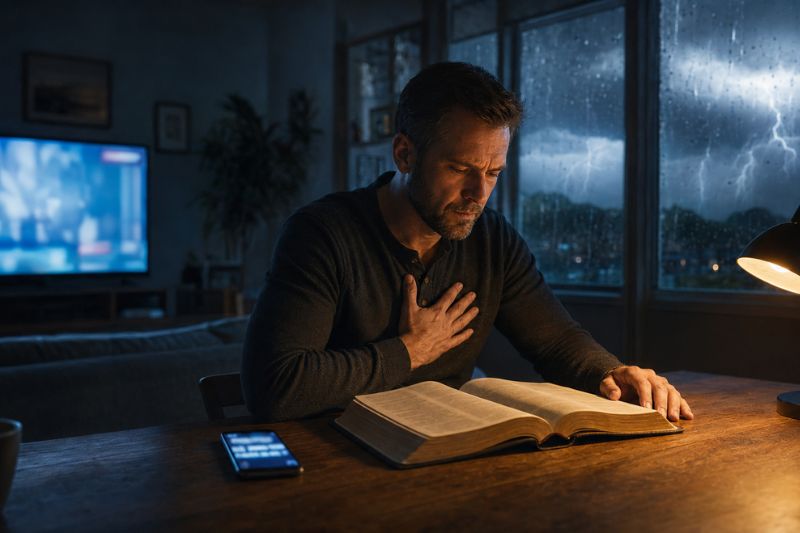
You turn on the television, scroll the headlines, or hear the report from a friend, and it lands in your body before you can stop it. Your stomach tightens. Your thoughts start running the worst-case scenario. Then you try to confess the Word over it, and the words come out flat. Not because the Word failed. Because your mind was still standing on the report while your mouth was trying to stand on the promise.
Since 2020, this has become a daily discipline instead of an occasional one. The pace of bad news has not slowed down, and neither has the pressure to let it set the tone of your day. A hollow confession is not proof that the Word has failed. It is proof of what is actually filling your heart and mind in that moment.
A good man out of the good treasure of his heart bringeth forth that which is good; and an evil man out of the evil treasure of his heart bringeth forth that which is evil: for of the abundance of the heart his mouth speaketh.
Luke 6:45 (KJV)
Whatever is abundant in your heart comes out when you open your mouth, even when the words sound like faith without feeling like faith. This is where the carnal, natural mind causes trouble. After the fall of mankind, it’s not natural for your mind to walk by faith. The natural mind is geared to walk by sight. When a bad report arrives, your mind can sometimes rush in with a conclusion that goes directly against what God’s Word says.
Peter is a picture of this. He was walking on the water by faith until he saw the wind was boisterous, and the instant he considered what his eyes were showing him, fear rose, and he began to sink.
But when he saw the wind boisterous, he was afraid; and beginning to sink, he cried, saying, Lord, save me.
Matthew 14:30 (KJV)
The water had not changed. What Peter looked at changed, and doubt was energized the moment his eyes left the Word and left Jesus and settled on the storm. Left unchecked, this is how a heart hardens, not all at once, but a little at a time, every time sight is allowed to outweigh the Word.
Take heed, brethren, lest there be in any of you an evil heart of unbelief, in departing from the living God. But exhort one another daily, while it is called To day; lest any of you be hardened through the deceitfulness of sin.
Hebrews 3:12-13 (KJV)
Unbelief rarely announces itself. It often sounds reasonable. It sounds like you are just being realistic about the report. That is the deceitfulness Book of Hebrews is warning about. It is exactly what a carnal mind walking by sight will always sound like.
The way out is not gritting your teeth harder. It is learning to magnify God instead of magnifying the report. When the twelve spies came back from Canaan, ten of them magnified the giants until the whole camp was afraid to move. Caleb and Joshua saw the same giants and magnified God instead.
If the LORD delight in us, then he will bring us into this land, and give it us… only rebel not ye against the LORD, neither fear ye the people of the land… the LORD is with us: fear them not.
Numbers 14:8-9 (KJV)
Same giants. Same report. Two completely different hearts, because each group chose what to make bigger in front of their own eyes. Doubt loses ground every time God gets bigger in what you say and see, and that is where a full confession, not just a repeated one, begins.
Casting down imaginations, and every high thing that exalteth itself against the knowledge of God, and bringing into captivity every thought to the obedience of Christ.
2 Corinthians 10:5 (KJV)
That word “casting down” is active. You take the thought captive on purpose, the same way you would remove an intruder from your house, before it has time to harden into unbelief.
Faith Lives in Your Heart, Not Your Mind
Mark 11:23 tells us to say to the mountain, but the verse does not end there. It says “and shall not doubt in his heart, but shall believe that those things which he saith shall come to pass.” The saying and the believing have to move together, and the believing is a heart matter, not a head matter. If you say the words but your heart has not settled on them, you are fighting the battle with your mouth alone while your heart sits on the sidelines agreeing with the bad report.
That if thou shalt confess with thy mouth the Lord Jesus, and shalt believe in thine heart that God hath raised him from the dead, thou shalt be saved. For with the heart man believeth unto righteousness; and with the mouth confession is made unto salvation.
Romans 10:9-10 (KJV)
This same principle applies whether you are receiving salvation or standing on any other promise of God. Your mouth makes the declaration, but your heart does the believing—and God responds to what is settled in your heart. This is why repeating a promise a time or two can feel ineffective. The Word hasn’t failed; it simply hasn’t had time to travel from your mind to your heart. After all, hearing a truth once rarely undoes weeks of bad news.
The mind still matters here, but not as the place faith lives. It is the gate the Word passes through on its way to the heart. Romans 12:2 calls this “the renewing of your mind,” and it is a real and ongoing process, but it serves the heart rather than replacing it. A renewed mind stops arguing with the Word long enough to let it reach the heart where believing actually happens.
And be not conformed to this world: but be ye transformed by the renewing of your mind, that ye may prove what is that good, and acceptable, and perfect, will of God.
Romans 12:2 (KJV)
Keeping the Word Before Your Eyes and In Your Heart
Proverbs 4 reveals exactly how the Word gets from hearing it to believing it with your heart.
My son, attend to my words; incline thine ear unto my sayings. Let them not depart from thine eyes; keep them in the midst of thine heart. For they are life unto those that find them, and health to all their flesh. Keep thy heart with all diligence; for out of it are the issues of life.
Proverbs 4:20-23 (KJV)
Notice the order. The Word goes in through the ear, is kept before the eyes, and settles in the midst of the heart. Out of the heart, not the head, come the issues of life. If you can see yourself with the answer already in hand, you are letting the Word stay before your eyes instead of letting it depart. That is what keeps it moving toward the heart instead of staying a fact you know but do not yet believe.
The mind still has a job to do. Your born-again spirit already has the answer. It holds what Christ purchased for you. Now, your mind must be renewed to line up with that truth. This renewing happens as you keep the Word before your eyes until your heart takes hold of it. In Isaiah 26:3, ‘stayed’ describes this exact state: a mind that stops wandering to the report and rests fully on what the heart believes.
Here is what this looks like in practice:
You let the promise settle in your heart before you read the report. You speak God’s Word over your health, finances, and family before the phone call comes—not to convince your mind, but because your heart already agrees.
You train yourself in faith by what you keep before your eyes, just as unbelief is trained by what you focus on. If the news gets ten minutes and the Word gets thirty seconds, you already know which one is settling in.
Philippians 4:8 gives the practical filter: whatsoever things are true, honest, just, pure, lovely, and of good report, think on these things. That is a standing instruction for every day the news hands you something that fails every one of those tests. You get to choose what stays before your eyes, and that choice is where your heart is shaped.
We covered this same principle from a different angle in anchoring your soul when anxious, and the two truths work together: an anchored soul and a mind stayed on God are the same posture applied to two different pressures.
The Difference Between Confessing Words and Confessing Faith
There is a difference between reciting a verse and confessing faith. Reciting a verse is repeating information. Confessing faith is declaring what has already settled in your heart as true, regardless of what the report says. The Shunamite woman in 2 Kings 4 did not say “it shall be well” as a formula. She said it because her heart was already settled on the God she knew, before she ever opened her mouth to Elisha’s servant.
That is why a confession spoken through gritted teeth while the heart is still gripped by fear falls flat, and a confession spoken from a heart already at rest carries weight. The words can be identical. The difference is what has taken hold beneath them.
If your confession has felt hollow, do not throw it out. Look beneath it. Deal with what your heart has actually taken hold of, and stop letting the report have more room there than the Word. Once your heart is settled, the same words you have been saying will stop feeling empty, because they will finally be backed by believing rather than wishing.
This is not a one-time fix. Some days the report will be louder than others, and your eyes will need to be brought back to the promise more than once before it settles in your heart for good. That is not a sign of weak faith. That is the discipline Isaiah 26:3 is describing, a mind kept stayed on what the heart already believes, not a mind that never wanders.
You may be reading this thinking, “This doesn’t sound very easy to do.” Let me be honest with you. Faith is a fight. We live in a fallen world and there’s no getting around that. Once you understand that Jesus already won the battle for us, you’ll begin to understand that the only fight we’re called to engage in, is the “Good Fight of Faith.” We’re not called to fight our neighbors, fight our coworkers, or anyone else. We’re called to fight the fight of Faith. And that’s what will enable you to overcome the tests and trials of Life.
Your Action Step
Before you consume any more news today, choose one promise that answers the fear that news tends to raise in you. Say it out loud, slowly, and let it stand before your eyes until it settles in your heart, before you check another headline. Do this every time the report tries to set the tone of your day, and watch your confession stop feeling hollow.
Your Word does not depart from my eyes. I keep it in the midst of my heart, and out of my heart flow the issues of my life. My mind is stayed on You, Lord, and You keep me in perfect peace, because I trust You. I will not lean the weight of my heart on the report. I lean it on Your Word, and Your Word does not change with the news.