
Now faith is the substance of things hoped for, the evidence of things not seen.
— Hebrews 11:1 (KJV)
Most believers treat faith and hope as two ways of saying the same thing. They use the words interchangeably — “I’m believing God” and “I’m hoping God will come through” in the same sentence, the same prayer, even the same breath. But they are not the same thing. Not even close.
This distinction is not a minor theological footnote. It is the difference between praying from a position of strength and praying from a position of need. It is the difference between a believer who stands and a believer who waits. Get this wrong and your prayer life will always feel like a coin toss. Get it right and everything changes.
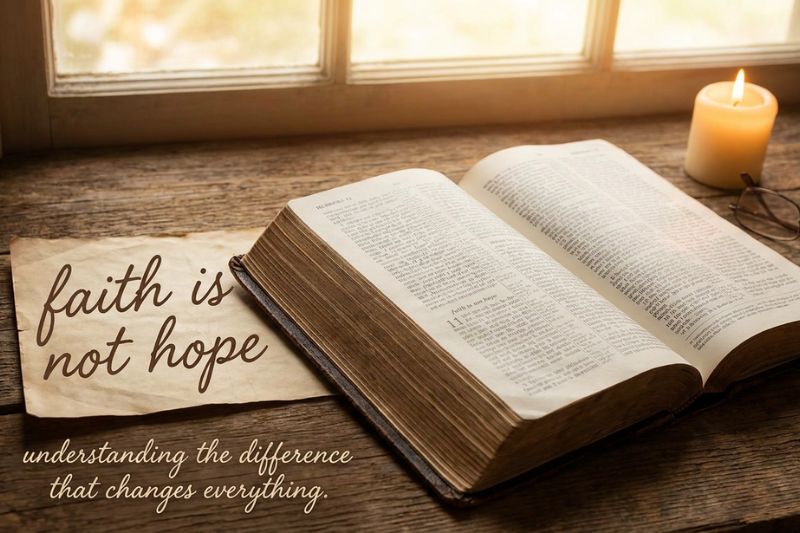
What Hope Actually Is
Hope is not a weak word in Scripture, and it is not the enemy of faith. But it does operate in a completely different dimension.
Biblical hope is a confident expectation of something that belongs to the future. It is a forward-looking certainty — the anchor of the soul as Hebrews 6:19 (KJV) calls it. Hope looks ahead to what God has promised and says, “That is coming.” That is a good and necessary thing. We hope for the return of Christ. We hope for the redemption of our bodies. There is a right and glorious hope that belongs to every believer.
But here is the critical line: hope operates in the future tense. “I hope to receive healing.” “I hope God will make a way.” That is always pointing forward, always waiting for a moment that hasn’t arrived yet.
When you pray from hope alone, you are praying from a distance. You are standing at the edge of the promise and looking toward it. That’s not the same as having it.
What Faith Actually Is
Look again at Hebrews 11:1 (KJV): “Now faith is the substance of things hoped for.” The word “substance” in the Greek is hupostasis — it means the actual essence, the foundational reality, the title deed. Faith is not the feeling that something might happen. Faith is the substance — the tangible spiritual reality — of the very things we hope for.
In other words, hope identifies what you are believing God for. Faith reaches into that hope and lays hold of it now, in the present tense, before any visible evidence arrives. Looking forward to the future is hope. Faith, however, only exists in the present tense.
And Jesus answering saith unto them, Have faith in God. For verily I say unto you, That whosoever shall say unto this mountain, Be thou removed, and be thou cast into the sea; and shall not doubt in his heart, but shall believe that those things which he saith shall come to pass; he shall have whatsoever he saith. Therefore I say unto you, What things soever ye desire, when ye pray, believe that ye receive them, and ye shall have them.
Mark 11:22-24 (KJV)
This is why Jesus did not say, “Believe you will receive it.” He said, “Believe that ye receive them” — past tense, when you pray. The receiving, in faith, happens at the point of prayer. What comes later is the manifestation of what you have already received in your heart.
Faith Lives in the Present Tense — Always
This is where most believers miss it. They know the promise. They are excited about the promise. They are confessing the promise. But underneath the confession, the posture of the heart is still “I hope this comes through.” That is hope dressed up as faith. And it will not produce the same results.
(As it is written, I have made thee a father of many nations,) before him whom he believed, even God, who quickeneth the dead, and calleth those things which be not as though they were.
Romans 4:17 (KJV)
Romans 4:17 (KJV) tells us that God “calleth those things which be not as though they were.” He does not call them as though they might be. He calls them as though they already are — because in the spirit realm, they already are. That is faith. That is the God-kind of faith operating in present-tense reality.
When Abraham received the promise of a son, the visible evidence was working against him. He was nearly one hundred years old. His body was as good as dead. Sarah’s womb was dead. But Romans 4:20 (KJV) says he “staggered not at the promise of God through unbelief; but was strong in faith, giving glory to God.” He was not hoping something would happen. He was giving glory for something that, in God’s eyes, had already happened. That is the model. That is what faith looks like.
The Practical Difference When You Pray
This distinction lands in the most practical way possible the moment you open your mouth to pray.
Hope-based prayer sounds like this: “God, I really need healing. I’m trusting that you might heal me. I believe you can do it, Lord. I’m hoping for a breakthrough.”
Faith-based prayer sounds like this: “Father, your Word says by His stripes I am healed (1 Peter 2:24, KJV). I receive my healing right now. I thank you that the answer is already done in the spirit. I call my body healed and whole in the name of Jesus.”
One prayer is reaching. The other prayer is receiving. One prayer is standing at the edge of the promise. The other prayer is stepping into it. Neither prayer is unspiritual. But only one of them is faith. And faith is what gets results. We can talk about sincerity, intensity, and emotion during prayer. All of those things are valid and have their place. None of them, however, is a substitute for faith.
But without faith it is impossible to please him: for he that cometh to God must believe that he is, and that he is a rewarder of them that diligently seek him.
Hebrews 11:6 (KJV)
Why the Church Has Mixed These Up
Most of what passes for faith in the church today is really hope. And the reason is simple: hope is natural. Hope is comfortable. Hope does not require you to call a thing done before you see it done. Hope allows you to stay a little hedged, a little protected, a little safe in case the answer doesn’t come.
Faith is bold. Faith makes a declaration. Faith says, “It is done,” before the manifestation arrives. And that feels risky to a mind trained by the world. But this is not presumption. Presumption is claiming something God has not promised. Faith is simply taking God at His Word — exactly as He gave it — and refusing to back down. You have to hold onto the Word of God and not let go, not waver, and not call it presumption when God said it first.
How This Changes Your Confession
If faith is present-tense and substance-based, your confession needs to match. You cannot confess the promise in the future tense and call it faith. “I believe I will be healed one day” is hope. “I am healed by faith in God’s Word” is faith. The tense matters.
This is why the practice of confession is so central to Word of Faith teaching. We are not trying to talk ourselves into something. We are aligning our mouths with what God has already declared in the spirit. We are calling things that be not as though they are — which is exactly how God operates (Romans 4:17, KJV).
The trying of your faith worketh patience (James 1:3, KJV). There will be a gap between the moment of faith and the moment of manifestation. During that gap, you are not hoping God comes through. You are thanking Him that He already has — and standing on that reality until it shows up in the natural. As we covered in the good fight of faith, that gap is where most believers quit. They slip from faith back into hope. The circumstances get louder than the Word. But quitting is not an option when you understand that faith already laid hold of the answer.
Your Action Step
This week, pick one area where you have been praying in hope — asking God to “please come through” — and make the shift to faith. Find the specific Scripture that covers your situation. Then stop asking for what the Word has already given you and start thanking God for it. Speak this confession out loud, once in the morning and once at night, until the manifestation arrives.
Father, I thank you that your Word is settled in heaven. I am not hoping — I am standing in faith. I have the substance of what I am believing you for, right now, in the spirit. Your Word does not return void. I call it done. I call it mine. In the name of Jesus, it is so.
Lastly, I understand why people sometimes respond to this kind of message the way they do. Well-meaning people say, “Are you saying it’s my friend’s fault that he died of cancer because he didn’t believe?!” Apply that same logic to basic salvation. “Are you saying it’s my friend’s fault he’s in hell because he didn’t believe in Jesus?”
Is there a balance? The disciples of Jesus who walked, talked, and lived with him for several years were admonished for their lack of faith more than once. After Jesus rescued Peter from sinking in the water, He asked, “Why were you so fearful?” That’s just one out of several instances. It’s really no different today. We can take our eyes off God and succumb to fear. Or, we can overcome through faith. It doesn’t change where you’re going if you believe in Jesus, but it does change how a situation can play out in the here and now.
We’ll end on that thought.