
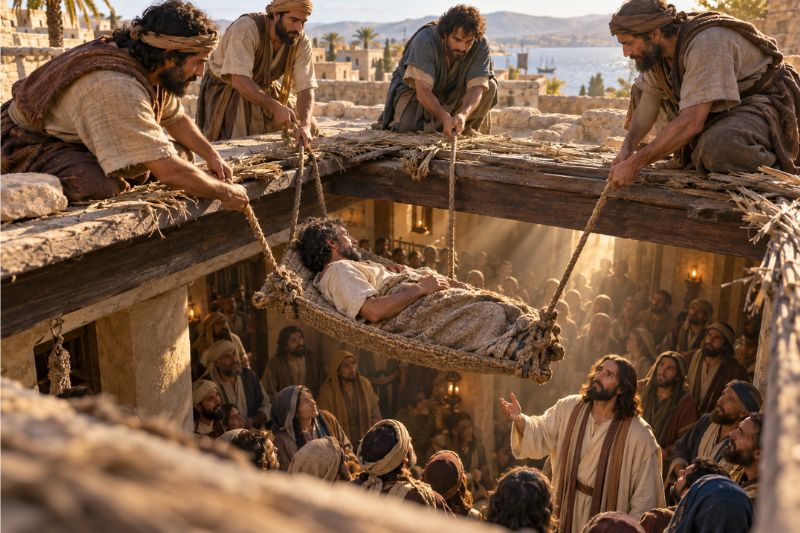
When Jesus saw their faith, he said unto the sick of the palsy, Son, thy sins be forgiven thee.
— Mark 2:5 (KJV)
Yes. You can have faith for someone else, and Mark 2:5 settles it in five words: when Jesus saw their faith. Not his faith. Their faith. A paralyzed man walked out of that house whole, and the record never once says he believed anything at all.
That single verse dismantles one of the most damaging ideas in the church today — the idea that if a sick person is not healed, the failure is theirs. Somebody did not believe hard enough. Somebody’s faith came up short. Read the Gospels honestly and you will find Jesus never said it, not one time.
Whose Faith Was Jesus Looking At in Mark 2:5?
Picture the scene. Jesus is teaching in a house in Capernaum. The place is packed to the doorway. Four men show up carrying a fifth man on a bed. He cannot walk. He cannot get himself in. There’s not a record of him asking anything.
And they come unto him, bringing one sick of the palsy, which was borne of four. And when they could not come nigh unto him for the press, they uncovered the roof where he was: and when they had broken it up, they let down the bed wherein the sick of the palsy lay. When Jesus saw their faith, he said unto the sick of the palsy, Son, thy sins be forgiven thee.
Mark 2:3-5 (KJV)
Look at what the man on the mat contributes to this story. He does not speak. He does not ask. He does not reach out and touch anything. He does not make a confession. He is carried in, he is lowered down, and he is healed.
The four men did the believing. They are the ones who decided he was going to Jesus. They are the ones who refused to be stopped by a crowd. They are the ones who climbed onto somebody else’s roof and started pulling it apart. Jesus looked at that and called it faith — and He acted on it.
Matthew records the same event with the same wording: “Jesus seeing their faith said unto the sick of the palsy” (Matthew 9:2, KJV). Two Gospel writers, same account, same pronoun. God moved on faith that belonged to somebody other than the man who needed the miracle.
Second-Party Faith Runs Through the Entire Gospel Record
If Mark 2 were the only account of its kind, you could argue it was an exception. It is not the only account. It is the pattern.
The Roman centurion came to Jesus about a servant lying sick at home (Matthew 8:5-13, KJV). The servant never met Jesus. The servant never said a word. The centurion understood authority — he knew that a command from Jesus would carry the same weight as a command from him to his own soldiers. Jesus marveled and said He had not found so great faith in all Israel, and the servant was made whole.
The woman of Canaan came about a daughter tormented by a devil. There is no indication anywhere in the text that the daughter believed anything.
Then Jesus answered and said unto her, O woman, great is thy faith: be it unto thee even as thou wilt. And her daughter was made whole from that very hour.
Matthew 15:28 (KJV)
Great is thy faith — spoken to the mother. Her daughter was made whole from that very hour. It didn’t matter that she was at a completely different location from her mother.
The list keeps going. Jairus came for a daughter who was dying, and by the time Jesus arrived she was dead; Jesus told the father “be not afraid, only believe” (Mark 5:36, KJV), which is a strange instruction to give a man if the dead girl’s faith is the deciding factor. Lazarus had been in the tomb four days. Nobody asks about Lazarus’s faith. The lame man at the Beautiful Gate was asking Peter and John for money, not for healing — and Peter later said plainly that it was the name of Jesus and faith in that name that made the man whole (Acts 3:16). Whose faith in that name? Peter’s.
Then there is the man at the pool of Bethesda, thirty-eight years an invalid. Jesus asked if he wanted to be made whole and the man answered with a complaint about having nobody to help him into the water (John 5:6-9, KJV). He did not know who he was talking to. He did not ask to be healed. He got up and walked anyway.
Once you start reading these accounts this way, a structure shows up in every one of them. There is someone with the power, someone with the faith, and someone with the need. Sometimes all three are the same person — the woman with the issue of blood pressed through the crowd on her own believing and pulled healing out of Jesus without Him even knowing who touched Him. But far more often, the one with the need and the one with the faith are two different people.
Where “They Just Didn’t Have Enough Faith” Actually Came From
Here is the question that exposes the whole thing. If the sick person’s own faith is what produces the healing, why did Jesus give His disciples power and authority over sickness and disease at all?
Think it through. If a sick man can get his own healing by believing, he does not need you, your authority, or the name of Jesus in your mouth. He can go straight to God himself. Authority over sickness is only meaningful if it can be exercised on behalf of somebody else. The commission makes no sense otherwise.
James makes it even more direct.
Is any sick among you? let him call for the elders of the church; and let them pray over him, anointing him with oil in the name of the Lord: And the prayer of faith shall save the sick, and the Lord shall raise him up; and if he have committed sins, they shall be forgiven him.
James 5:14-15 (KJV)
Read what the sick person is actually assigned to do. Call for the elders. That is the entire list. Once the elders arrive, the responsibility shifts to them — let them pray over him. And it is the prayer of faith that saves the sick, prayed by the ones who came. It never says the sick man’s faith will heal him.
Notice the last clause too. If he has committed sins, they shall be forgiven him. Sin in the sick person’s life did not cancel the healing and did not stop the faith of the elders. That should tell you something about how much of this rests on the person in the bed.
So where did the other doctrine come from? It came from the need for an explanation. When someone prays and nothing visible happens, there are only two places to put the responsibility: on the person who prayed, or on the person who was prayed for. Put it on the sick person and the minister keeps his reputation. Notice how quickly that arrangement reverses when the healing does happen — then it is the anointing, the gifting, the man of God. Heads I win, tails you lose.
Jesus never operated that way. When He rebuked people for unbelief, He rebuked His own disciples — and He rebuked them not for failing to get healed, but for failing to heal somebody else. A father brought a tormented boy to them and they could not deliver him. Jesus cast the devil out and the disciples asked why they could not.
And Jesus said unto them, Because of your unbelief: for verily I say unto you, If ye have faith as a grain of mustard seed, ye shall say unto this mountain, Remove hence to yonder place; and it shall remove; and nothing shall be impossible unto you.
Matthew 17:20 (KJV)
The boy was not scolded. The father was not scolded. The men holding the authority were. If you are the one standing in the gap, the believing is your assignment, and this is worth understanding before you take it on — because believing gets hard when you are the one under the pressure, and it gets harder still when the person you love is losing ground in front of you.
Building Your Own Faith Is Still the Goal
None of this is permission to stay a spiritual passenger. It is a mercy, not a strategy.
If you never develop your own faith, you are permanently dependent on somebody else showing up in faith at the moment you need it — and you have no way of knowing whether that person is where they need to be with God. That is a hard place to live. This is why you have to believe it for yourself is not a contradiction of anything you have read here. It is the goal.
There is a second reason, and it is the more important one. You cannot carry anybody with faith you do not have. The four men in Mark 2 could lower that mat because they had something to lower it with. If you want to be useful to the people around you — the ones who are too sick, too discouraged, or too far from God to believe for themselves right now — you have to be building. Faith comes by hearing, and hearing by the word of God (Romans 10:17, KJV). There is no shortcut and there is no substitute.
How to Carry Someone Who Cannot Carry Himself
Here is what standing for another person actually looks like in practice.
Settle the will of God before you start. You cannot carry anyone while you are still asking whether God wants them well. Jesus went about doing good and healing all that were oppressed of the devil, for God was with Him (Acts 10:38, KJV). Sickness is the oppression. God is the deliverer. Settle that once and stop reopening it every time the symptoms flare.
Take the assignment yourself. The four men did not stand around the bed coaching their friend to work up faith. They picked up the corners. Stop waiting for the person to produce something they do not have right now, and start doing the believing on their behalf.
Refuse the obstacle. There was a legitimate reason to quit that day. The house was full and there was no way in. They went through the roof. Faith is not polite about obstacles. Whatever is currently standing between that person and their answer, treat it as something to be removed rather than something to be respected.
Speak to the condition, not about it. God calls those things which be not as though they were (Romans 4:17, KJV), and He tells us to do the same. Reporting the diagnosis over and over is not faith, it is agreement with the problem. This is the same principle at work when you believe you receive it and you shall have it — you settle it in the spirit first and hold the line until the natural catches up.
(As it is written, I have made thee a father of many nations,) before him whom he believed, even God, who quickeneth the dead, and calleth those things which be not as though they were.
Romans 4:17 (KJV)
Do not let their unbelief become yours. This is where most people lose the fight. The person you are standing for will say discouraging things. They will tell you it is not working. They may tell you flat out that they do not believe in any of it. That is theirs. It is not yours, and it does not have to become yours.
John G. Lake had a man come into his office who announced up front that he had no faith in doctors, no faith in men, and no faith in God. Lake’s answer was that it did not matter — he had enough faith for the both of them. He set the man’s cane aside, talked with him about ordinary things, prayed, and sent him on his way. The man walked out without the cane and did not even realize what had happened until later. His unbelief was never the deciding factor, because it was never the thing being counted on.
If you allow the Holy Spirit to give you a revelation and insight into this topic we’re discussing today, your life will never be the same. It will be a turning point in your journey through life.
Your Action Step
Name one person this week. Not a list — one. Someone who is not able to believe for themselves right now, whether that is because they are too sick, too discouraged, too angry at God, or too far from Him to try. Write their name down and write down the specific thing you are standing for. Then stop asking God whether He is willing, and start thanking Him for the manifestation. Say this out loud over that name every day this week.
I have the same faith that raised Jesus from the dead living on the inside of me. I am not waiting on ______ to believe — I believe. Jesus gave me authority over sickness and disease, and I exercise it now on ______’s behalf. In the name of Jesus I break the power of this thing off of ______ and I call them whole, restored, and free. Their unbelief is not my problem, because my faith is not resting on them. It is resting on the Word of God, and the Word of God is settled. It is done. I thank God for the manifestation.