
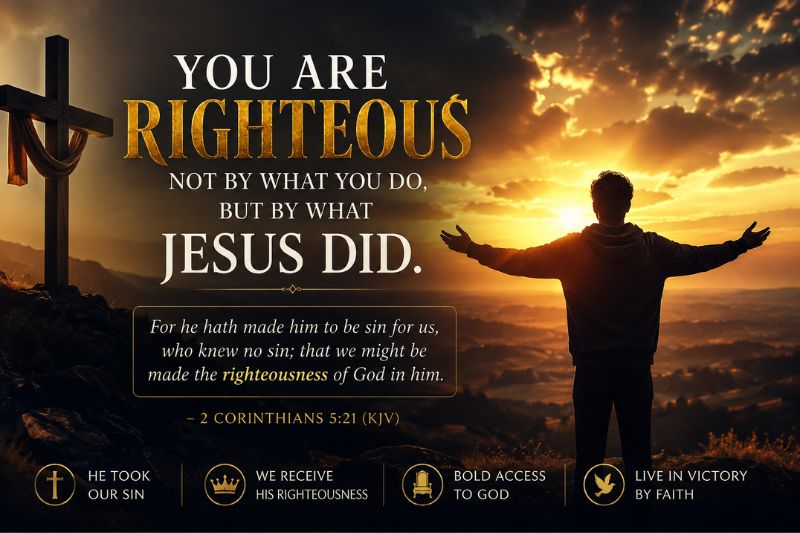
For he hath made him to be sin for us, who knew no sin; that we might be made the righteousness of God in him.
— 2 Corinthians 5:21 (KJV)
Are you righteous? Yes. Not because of what you did this morning, not because of what you didn’t do last night, but because God made you righteous the moment you were born again. Righteousness is not a reward you earn through good behavior. It is a gift you received through the finished work of Jesus Christ, and it became who you are the instant you believed on Him.
Most believers never settle this. They spend years measuring their standing with God by their performance, and the enemy uses that scale to keep them in condemnation. But 2 Corinthians 5:21 does not describe a process. It describes an exchange that already happened. Jesus took your sin so completely that God’s own righteousness became yours in return. Today we are going to settle, once and for all, what that means for you.
You Don’t Earn Righteousness. You Receive It.
The word righteousness makes most people think of behavior. They picture a scale, with good deeds on one side and sin on the other, and they assume God is waiting to see which side wins. That picture is not the gospel. It is religion, and religion always ends in exhaustion because the scale never stops moving.
Scripture describes righteousness as something given, not earned. Under the old covenant, righteousness was tied to keeping the law perfectly, and no one could sustain that for long. That covenant exposed sin. It was never designed to remove it. Paul spent the first half of Romans dismantling any idea that righteousness could come from human effort, because if it could, Jesus would not have needed to die.
Paul was direct about where righteousness actually comes from.
But of him are ye in Christ Jesus, who of God is made unto us wisdom, and righteousness, and sanctification, and redemption.
1 Corinthians 1:30 (KJV)
Jesus Christ was made your righteousness. Not your effort. Not your church attendance. Not how long you have gone without losing your temper. Righteousness came from Him and was placed on you the moment you believed. Once you see that, you stop trying to qualify for something you already have, and you start standing in it.
The Great Exchange: He Became Sin So You Could Become Righteous
Look again at the main verse. He hath made him to be sin for us, who knew no sin, that we might be made the righteousness of God in him. That is a trade, and it is the most lopsided trade in history. Jesus, who never sinned one time, took your sin as though it were His own. In exchange, you received His righteousness as though it were your own. That is not a partial swap. It is a total exchange, settled at the cross and confirmed at the resurrection.
This is why we never say sickness, poverty, or failure are lessons God is teaching you through hardship. God is not the author of what tears you down. He already gave His Son to take your sin, your sickness, and your shame off of you permanently. Every attack against your identity, every accusation that says you are not good enough, comes from the enemy, not from your Father. God settled your righteousness at the cross. The enemy’s only strategy left is to talk you out of believing it.
Romans confirms the exchange was not partial or conditional.
For if by one man’s offence death reigned by one; much more they which receive abundance of grace and of the gift of righteousness shall reign in life by one, Jesus Christ.
Romans 5:17 (KJV)
Righteousness is called a gift here, and gifts are received, not earned. You did not work for your salvation, and you do not work for your righteousness. You receive both the same way, by faith in what Jesus already accomplished.
This matters because righteousness is what gives you standing to approach God with confidence. It is not a badge you display for others. It is your legal access to His presence, His promises, and His power. Hebrews describes this access directly.
Let us therefore come boldly unto the throne of grace, that we may obtain mercy, and find grace to help in time of need.
Hebrews 4:16 (KJV)
Boldly, not timidly. You do not come to God hoping He might overlook your shortcomings. You come as someone already declared righteous, with full access, because the exchange at the cross already settled the terms.
Your Born-Again Spirit Is Already Righteous
Here is where many believers get stuck. They look in the mirror, or they remember something they said in anger, and they conclude the verse cannot be talking about them. But righteousness was never a statement about your mood, your history, or your flesh. It is a statement about your born-again spirit.
You are spirit, you have a soul, and you live in a body (1 Thessalonians 5:23). When you were born again, it was your spirit that was recreated, instantly and completely.
Therefore if any man be in Christ, he is a new creature: old things are passed away; behold, all things are become new.
2 Corinthians 5:17 (KJV)
That new creation was formed in righteousness. Ephesians states it plainly: your new nature was created in righteousness and true holiness (Ephesians 4:24). This is not describing your final destination in heaven someday. It is describing your spirit right now. Your spirit is not becoming righteous over time the way you might grow in wisdom or maturity. It was made righteous the moment you were born again, and it has not needed improvement since.
This is why the mirror can lie to you if you let it. You can look at your reflection, remember a harsh word you spoke, or replay a decision you regret, and none of it changes what happened in your spirit the day you were born again. Your body ages. Your soul still needs daily renewing. But your spirit was made complete in righteousness the instant you believed, and it has been standing at full strength ever since, whether you have recognized it or not.
Peter confirms this same standing was never something believers worked toward. He addressed his letter to those who obtained it.
Simon Peter, a servant and an apostle of Jesus Christ, to them that have obtained like precious faith with us through the righteousness of God and our Saviour Jesus Christ.
2 Peter 1:1 (KJV)
Obtained, past tense. Peter was not writing to believers who were working toward righteousness someday. He was writing to people who already had it, the same way you already have it.
One of the most important revelations you’ll ever receive from the Bible is the insight into what we already have and what was already done for us. When that happens, we begin to rest in the promises instead of working to receive them.
The reason your feelings do not always line up with this truth is that your soul, your mind and emotions, has not yet been renewed to agree with what already happened in your spirit. That is not a righteousness problem. It is a renewing problem, so let’s talk about that next.
Why the Enemy Keeps You Chasing What You Already Have
If righteousness were something you had to earn, the enemy would just have to point at your failures to convince you that you don’t have it. But since righteousness is a settled gift, his strategy has to be different. He cannot take it away from you, so instead he works to keep you from believing it, confessing it, and walking in it. Condemnation is his primary weapon, and it is a weapon aimed directly at your identity.
Scripture calls him by name for exactly this role.
And I heard a loud voice saying in heaven, Now is come salvation, and strength, and the kingdom of our God, and the power of his Christ: for the accuser of our brethren is cast down, which accused them before our God day and night.
Revelation 12:10 (KJV)
The accuser, not your Father, is the one bringing the charges. Every thought that says you are too far gone, too inconsistent, or too messed up to be called righteous did not originate with God. Romans 8:1 settles the matter: there is therefore now no condemnation to them which are in Christ Jesus. If God is not condemning you, and He is not, then any voice telling you otherwise is not His voice.
Notice the timing in Revelation 12:10. The accuser brought his charges day and night, without pause. That should tell you something. If condemnation were coming from God, it would carry weight and finality. But this accusation is relentless and repetitive, because it has no legal ground to stand on. It only works if you agree with it. The moment you stop agreeing and start declaring what God already declared over you, the accusation loses its power, not because the enemy gave up, but because you stopped cooperating with a lie.
Doubt about your righteousness is not humility. It is a correctable error, and you correct it the same way you correct any lie: by lining your thinking up with the Word until the lie loses its grip. This is not something you do once. It is a stand you take every time the accusation shows up again.
Renewing Your Mind to Agree With Your Spirit
Your spirit does not need to be convinced it is righteous. It already is. Your mind is the part that needs renewing until it agrees with what is already true in your spirit.
And be not conformed to this world: but be ye transformed by the renewing of your mind, that ye may prove what is that good, and acceptable, and perfect, will of God.
Romans 12:2 (KJV)
This renewing happens through what you say and what you dwell on, not through willpower. When you catch a condemning thought, do not argue with it in your own strength. Answer it out loud with the Word. Say what God says about you instead of repeating what your feelings or your past are saying. This is not positive thinking. It is agreeing with a legal reality that God already established at the cross.
Practically, this means paying attention to your self-talk the same way you would pay attention to a lie told about you by someone else. If a stranger accused you of something untrue, you would correct them. Treat condemning thoughts the same way. Interrupt them mid-sentence with the Word. Over time this is not a one-time decision but a daily discipline, the same way physical exercise builds strength through repetition. Each time you choose God’s declaration over your feelings, the pathway between your spirit and your soul gets clearer, and the settled righteousness that has been true of you all along becomes the thing that actually governs how you think, pray, and respond to pressure.
Your Action Step
Stop waiting to feel righteous before you call yourself righteous. Feelings follow confession, not the other way around. Today, choose one moment where condemnation typically hits you, whether it is after an argument, after a failure, or in the quiet of the night, and meet it head on with the confession below. Speak it out loud. Do not whisper it as a hope. Declare it as a settled fact.
I am the righteousness of God in Christ Jesus. I did not earn this and I cannot lose it by my performance, because it was never based on my performance. Jesus became sin so that I could become righteous, and that exchange is finished and settled. I refuse every accusation the enemy brings against me. I am not who my past says I am. I am who God says I am, right now, in my spirit. I stand in right standing with my Father today.