
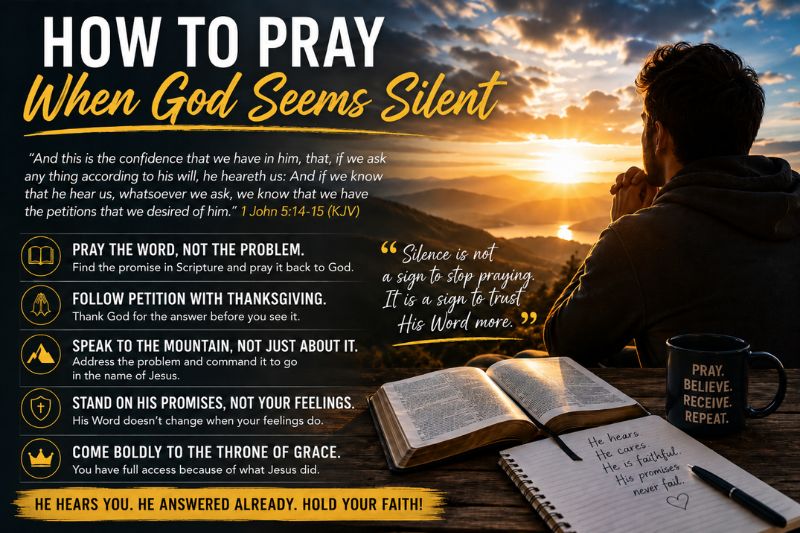
You prayed. You believed. And now all you hear is silence. If you have ever knelt down with everything you had and still felt like your words bounced off the ceiling, this post is for you. The good news is not that the silence means nothing: it is that God’s Word already answered the question before you felt the doubt. He hears you. The issue is never His willingness. It is always our understanding of how prayer works.
And this is the confidence that we have in him, that, if we ask any thing according to his will, he heareth us: And if we know that he hear us, whatsoever we ask, we know that we have the petitions that we desired of him.
1 John 5:14–15 (KJV)
Read that again slowly. John does not say maybe He hears. He does not say sometimes He answers. He says we know: present tense, settled, done. That is not wishful thinking. That is the legal standing of every believer who comes to God on the basis of His Word.
Why Prayer Feels Unanswered (And Why That Feeling Lies)
There is a difference between God not hearing you and you not feeling heard. Feelings are real, but they are not the final authority. Every believer has walked through a season where prayer felt like shouting into the dark. That is not a sign that God has gone quiet: it is a sign that the enemy wants you to abandon your post.
I have been there. I have prayed and then thanked God for weeks on end and watched the circumstances get worse before they got better. I have had moments in the middle of the night where doubt pressed in hard. Moments when it felt like I wasn’t trusting God because had I been trusting, I wouldn’t be feeling a certain way. What I learned, the hard way, is that what looks like silence from God is almost always a gap between the spiritual reality and the physical manifestation. The answer already exists in the spirit. The fight is to hold your position until it shows up in the natural world.
Simply put, God has already provided everything you need through Jesus Christ. Prayer is not convincing a reluctant God to act: it is receiving what has already been given. The moment you shift from begging to receiving, the whole dynamic of your prayer life changes.
What “According to His Will” Actually Means
First John 5:14 says the confidence of answered prayer rests on asking “according to his will.” Many believers read that phrase and immediately get uncertain: But how do I know what His will is? The answer is simpler than religion has made it.
His will is His Word. If it is in the Bible, it is His will. Healing? His will (Isaiah 53:5, Matthew 8:17). Provision? His will (Philippians 4:19). Peace in the storm? His will (John 14:27). When you pray the Word back to God, you are not guessing at His will: you are declaring it. That is not arrogance. That is the prayer of faith that James 5:15 says shall save the sick.
The phrase “if it be thy will” belongs in one place only: when you are genuinely uncertain whether Scripture addresses a specific situation. It does not belong attached to promises God has already made. You would not say “Lord, please forgive me, if it be thy will.” You know it is His will because 1 John 1:9 says so. Apply that same boldness to every promise in the Book.
Three Things to Do When God Feels Silent
Silence is not a sign to stop praying. It is a sign to change your posture: not from prayer to doubt, but from petition to thanksgiving. Here is the pattern that works:
1. Speak and Pray the Word, not the problem. Most of us describe the problem to God in detail when we pray: the diagnosis, the bank balance, the broken relationship: as though He needs updating. What He is waiting for is a prayer that lines up with what He has already said. Find the scripture that covers your situation and pray that back to Him. “Father, your Word says by the stripes of Jesus I am healed. I receive that healing now in Jesus’ name.” That is a prayer He has already answered.
2. Follow the petition with thanksgiving. Philippians 4:6 does not say pray and worry. It says pray with thanksgiving. After you present your request, shift immediately into thanking God for the answer: before you see it. This is not denial of the problem. This is faith expressing itself. Thanking God in advance is not a formula: it is the natural response of a heart that actually believes He heard. You can act like the Bible is true, or you can act like a person who doesn’t believe God has heard them.
3. Speak to the mountain, not just about it. Mark 11:23 says whosoever shall say unto this mountain: not whosoever shall think about it, worry about it, or talk to God about it. Jesus told His disciples to speak directly to the obstacle. Address the sickness. Address the debt. Address the fear. Tell it that God’s Word has already settled the matter, and command it to go. This is not name-it-claim-it. This is the authority of the believer in action.
The Confidence That Does Not Depend on What You Feel
First John 5:15 uses a word that is worth camping on: confidence. The Greek word is parresia: it means boldness, openness, freedom of speech. It is the word used of how a citizen approaches a king with full legal right to be heard. You do not crawl into the throne room of grace. You come boldly (Hebrews 4:16): not because of your own merit, but because Jesus paid for your access.
That confidence is not manufactured by emotion. It does not appear when you feel spiritual enough or when the circumstances look favorable. It comes from knowing what the Word says and choosing to stand on it regardless of what the five senses are reporting. That is the fight of faith, and it is a fight worth taking.
When you do not feel like God is listening, the answer is not to pray harder or pray louder. The answer is to anchor yourself to what is already written and refuse to move from it. The Word does not change when your feelings do. And a prayer rooted in the Word is a prayer that has already been heard.
Plant Your Flag Here
If prayer has felt like a one-way conversation lately, make a decision today. Not a feeling, a decision. You are going to take God at His Word. You are going to come to Him on the basis of 1 John 5:14–15 and not on the basis of what you see or feel. The silence does not mean He is absent. It means you are in the gap between the promise and the manifestation, and that is exactly where faith does its best work.
Say this out loud right now:
“Father, I come to You on the basis of Your Word. First John 5:14–15 says that if I ask anything according to Your will, You hear me, and if You hear me, I have the petition I asked of You. I am asking in line with Your Word, and I receive the answer now by faith. I thank You that You are not silent. I thank You that my prayer is heard. I choose to stand on Your Word and not on what I feel. In Jesus’ name, amen.”
Now hold that position. Do not pray it and then contradict it with your mouth for the rest of the day. Speak in line with what you just confessed. The Word you stand on today is the harvest you walk into tomorrow.
Have you ever had a season where prayer felt impossible? Feel free to email us and tell us what you held on to. Your testimony may be exactly what someone else needs to hear today.